Showing posts with label loss. Show all posts
Friday, August 12, 2011
Loss of a pet, dealing with loss and autism
I had something else I wanted to touch on today, but I'm switching things up again. Sometimes current events demand attention. You never know what surprise may overtake you.
Cupid the pet rat was very sick and suffering. She wasn't drinking water and barely ate the food I gave her. Despite cage cleanings, she had contracted mites (they are very common and can come from almost anywhere). Despite treatment, they could not be stopped or gotten rid off. I will have to throw her cage out to be sure they're gone because of how hardy these nasty vermin turned out to be. Our other rat doesn't have them, thankfully.
It's never easy to send a pet friend on their way and sadly, I had to do this last night. Now, let me tell you, I have a great deal of experience in this unfortunate skill from working with animals as long as I have. I was a breeder of rats long, long ago and I worked for an Animal Control Agency for six years. In that time, I've had to put down all manner of injured wildlife. I had to put down many a sick rat with cancerous tumors or other ailments that prevented them from thriving. When you cold have 10 litters of rats growing at numbers of 20 per litter (average), it was impossible to avoid.
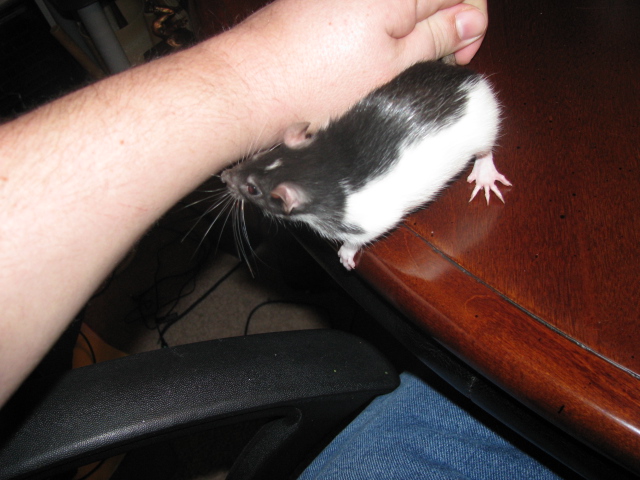
Anyway, Cupid was very special. She would let you pick her up and take her anywhere. She would let a hyper child with autism hold her. She would ride on our shoulders and nestle into anyone's long hair. She was cute and loveable. She could teach you to enjoy a rat's company. My son was very attached to her. I hated what I had to do. I hated to deliver the news as well. He fell into my lap when I told him she had to go last night. He cried for a good ten minutes as I discussed how I understood his feelings.
I offered to do a burial in the backyard and he accepted readily. Out in the back yard is the remains of an old stump someone tried to burn out. It's center was only dirt and ashes. Looking around the yard, I realized that there would likely be nothing under the stump. It should be safe to dig there. So I did and I managed to get the hole a good foot and half deep before digging into hard clay. We put poor Cupid to rest there and my son said a few words of goodbye. Then we filled it in and talked some more.
Loss is a hard change and change is already hard for autistics. All you can do, is be supportive and understanding. Offer to do things that help bring closure and remind of the good times. Don't go for instant replacement. Time is needed to get full closure or anything close to that. In getting a new pet, you shouldn't be getting a replacement. You should be getting a "new" pet, with an identity and history all it's own. That way, you don't find yourself constantly looking at this new animals as a replacement for Fido or who ever.
We still have a family of pets that need our love and support. We still have a big ol boy rat named Mocha Joe who needs attention. He's not the same, but we still have him and he is who he is. My son will be fine, but it's a tough loss for any child, conditions or not.
Labels:
aspergers,
autism,
Dave Wilde,
death,
DJ Wilde,
loss,
pets,
thewildeman2
Sunday, May 10, 2009
Autism and Trauma Part 4: Crime and Loss
I wrote some time ago about my son's missing toy dog, named Nunya. It was his very favorite and once in a while he brings it up and can't let it go. It brings him to tears that we can't find it. I can only reassure him that perhaps it's in a better place or some spot we just haven't been able to reach. I don't know how his little stuffed dog vanished, but it's gone. I've taught him that sometimes we lose things and there's really nothing we can do about it. It is a lesson I will have to reteach him and reinforce for years to come. It will nearly always be over the same lost toy. That's how hard it is for an autistic child to let go of a lost object. It's traumatizing and requires additional support and teaching.
That's not to say that loss isn't difficult for the typical child or person, it's just harder at much simpler levels than it takes for a typical child. Traumatic loss can break an autistic's world and cause regression and depression. Not good things for our kids to have on any level.
The response for this is redirection, reassurance of positive things and possibly even therapy. It's important to be quick to teach and react so that you can start working on corrective support right away.
Even worse is the nightmarish idea that any of our children could be the victim of a crime. I know of one case where I cannot give names. The autistic child was molested by a teacher. What made this case particularly difficult was the fact that the child was already fairly non-verbal. Victimizing a child is a heinous act, moreso to me, when it involves a child with disabilities. The truth could still be found however in therapy, doctors assistance, and parents who know their children. His behavior changed enough that they knew something was wrong. What about those who are even less functioning? How much function do you think they will gain?
If you said they will lose function and may regress into themselves, you got the bull's eye! Children with most forms of autism, even if high functioning are considered gullible and may not realize they are in danger. They are twice as likely to believe a stranger's lies even if told not to. That's why you have to reinforce all teachings here more than with any typical child.
Everywhere I go, I reinforce with my son that he must stay right beside me and I often have a hand on his shoulder or I hold onto a portion of his shirt in my fingers. I don't do this harshly, rather lightly. If I feel his clothing slip from my fingers, I know I need to see what he is doing. My own high sensitivities help me to keep an eye on him and register even the slightest movement he makes. I never allow him to leave my sight alone with anyone I don't know. Even in my local Doctor's office, that is small and highly trustworthy, I'm nervous if he's out of sight. Overprotective? You bet I am.
Even so, there is always the chance of something happening to our children that is out of our control. We have to make sure that we are there for our children no matter what. Take reports seriously and investigate them. Get them proper treatment and support with fire alarm haste. Early intervention and support are key in treating trauma for crime victimization.
While this isn't as common as bullying, it's damage capability cannot be ignored.
Part five is the last part of my blog series on the effects of trauma on autism. I hope that you can see the differences in the types of trauma and how they can affect the autistic so much faster and harder than with a typical person. In the same manner it is also more difficult to treat because of the social disabilities that they have. It's hard enough to understand the social world around us, but hurt us with it and it's just that much worse.
That's not to say that loss isn't difficult for the typical child or person, it's just harder at much simpler levels than it takes for a typical child. Traumatic loss can break an autistic's world and cause regression and depression. Not good things for our kids to have on any level.
The response for this is redirection, reassurance of positive things and possibly even therapy. It's important to be quick to teach and react so that you can start working on corrective support right away.
Even worse is the nightmarish idea that any of our children could be the victim of a crime. I know of one case where I cannot give names. The autistic child was molested by a teacher. What made this case particularly difficult was the fact that the child was already fairly non-verbal. Victimizing a child is a heinous act, moreso to me, when it involves a child with disabilities. The truth could still be found however in therapy, doctors assistance, and parents who know their children. His behavior changed enough that they knew something was wrong. What about those who are even less functioning? How much function do you think they will gain?
If you said they will lose function and may regress into themselves, you got the bull's eye! Children with most forms of autism, even if high functioning are considered gullible and may not realize they are in danger. They are twice as likely to believe a stranger's lies even if told not to. That's why you have to reinforce all teachings here more than with any typical child.
Everywhere I go, I reinforce with my son that he must stay right beside me and I often have a hand on his shoulder or I hold onto a portion of his shirt in my fingers. I don't do this harshly, rather lightly. If I feel his clothing slip from my fingers, I know I need to see what he is doing. My own high sensitivities help me to keep an eye on him and register even the slightest movement he makes. I never allow him to leave my sight alone with anyone I don't know. Even in my local Doctor's office, that is small and highly trustworthy, I'm nervous if he's out of sight. Overprotective? You bet I am.
Even so, there is always the chance of something happening to our children that is out of our control. We have to make sure that we are there for our children no matter what. Take reports seriously and investigate them. Get them proper treatment and support with fire alarm haste. Early intervention and support are key in treating trauma for crime victimization.
While this isn't as common as bullying, it's damage capability cannot be ignored.
Part five is the last part of my blog series on the effects of trauma on autism. I hope that you can see the differences in the types of trauma and how they can affect the autistic so much faster and harder than with a typical person. In the same manner it is also more difficult to treat because of the social disabilities that they have. It's hard enough to understand the social world around us, but hurt us with it and it's just that much worse.
Subscribe to:
Posts (Atom)