It just happened and the news hits you like a runaway truck. You experience a mixture of relief and shock. Relief at having a name for the thing you didn't understand and shock because you still have no idea what to do about it. Better yet, your doctor may not know what you should do either. It's bad enough that parenting doesn't come with automatic instructions, but you have far more to learn than the average parent.
Well you aren't alone and this write up is geared to give you more than one place to start.
I am an adult with autism raising a teenager with autism. I've been on your path and then some. Not only did I have to relearn everything I thought I knew about parenting, I had to relearn myself. This advice will by no means cover every thing you could face. Every child is different and how heavily they are affected by autism is vastly different. That's why it's called "the spectrum". Which leads to my first point:
Get to know your child: Sure, every parent has to do this, but you are watching for intricate details that others will take for granted. You are watching for triggers in sensory that others don't commonly react to. You are watching for extreme behaviors that demonstrate super interest or reaction or almost NO interest or reaction. These will be noteworthy to you so you can help your child interact with a loud and intense world. Look for both the things that aggravate and provide comfort. For example, if hiding under a blanket calms a meltdown, you best have a blanket with you on outings. There are three subjects that I use to teach people about autism in children. They are as follows:
-Sensory: Various sensory (your five senses) "problems" or imbalances are common in autism. Colors and lights may be super bright and overbearing. Sounds may be too loud and invasive. Textures may cause extreme discomfort. Yet, some sensory issues may do the opposite so much that your child seeks them out constantly. These can be very strange behaviors. The list is long and some behaviors can be disturbing. The good news is that your child will develop past hundreds of these behaviors. Behaviors as a toddler are by no means bound to be permanent. And by no means should you think you cannot teach your child alternate behaviors. You absolutely can.
-Routine: The order in which you do daily activities is something your child will likely become very sensitive of. Changes in routines may be met with severe resistance. This includes issues like change of wardrobe from one season to the next. As they grow, clear information on how and why of changes may help. Again, these are teaching points for you as the parent. It's simply something you will have long term work on with your child. The forms of many sensitivities will change with age. Just know, that if you teach them to brush their teeth before getting dressed and one day you switch that around, it may become a very difficult day.
-Social: Social interactions are heavily affected by sensory and some delayed maturity issues (but not just those). Social interactions have a tendency to go one of two directions; too little or way too much. Lack of eye contact or "appropriate" response to your emotions (anger or praise) are just the beginning. Clear and literal information can be of utmost importance. For example, my wife summoned my son to his messy bedroom where he had tossed dirty clothes down in his doorway. She asked him "what is wrong with this picture?". My son became very nervous because, while he saw the mess on his floor, he did not see a "picture" anywhere. If she had asked "what is wrong with these clothes?" he would have understood immediately. You're child will have to be taught very specifically what it means when you are happy with him or not. Just expressing the emotions, will likely not work the same as with a typical child. As an additional caution, never spank an autistic child. It will ignite sensory triggers, cause huge meltdowns, and teach them that it's okay to hit you and others. When I say that you will have to learn a whole different way of parenting it is not a casual reflection.
Be involved with your child: Your child needs you more than ever to help them understand how to live in our crazy world. I'm going to make a suggestion that has helped my own son in so many ways.
Play games.
Yes, games. I play and collect heroclix with my son. It's a table top game with tiny figurines of comic book super heroes played out on a map. I developed short term variations of the rules for my son to enjoy at a very young age (about 8). It helped him with social interaction, math, and problem solving. He still loves the game to this day. He has fond memories of interactions with those games. How to react to winning or losing and the random chances of the dice are incredible tools that can be integrated into teaching how the world works in real life. It's creative parenting at its best.
Finally, let me tell you that (while you are understandably shaken now) you have become the parent of a very special form of person. He or she is going to show you things about life you never thought possible. Get ready, because it's going to be quite a trip.
Showing posts with label aspergers. Show all posts
Showing posts with label aspergers. Show all posts
Thursday, November 19, 2015


Wednesday, August 6, 2014
Bringing the blog back to life

About those causes. Just what are they? Well, if this is your first time on this blog and you don't really know me, I'm DJ Wilde (author, artist). I have Asperger's Syndrome (no I don't care if its not in thediagnosis manual anymore) Multiple Sclerosis, and a Traumatic Brain Injury. Life is a challenge on the best of days, but I press on and that's an important message I want to convey. Now, I am also the parent of a child with autism (he's 12 as I write this). I grew up without any of the supports you see today and without diagnosis. So those things are extremely important to me, especially for my son. I also want to see more of our autistic youth get the support they need. When someone with autism does something awesome, you may well find it here. Support news? Yep. And every once in a while a rant on some wrongdoing to someone.
As an independent author and artist kicking off his own universe, I'm bound to mention that here. But there's also Galaxy Zento, the blog to consider. I'll be doing articles on independent comic or fantasy artists. People who's work I admire and want to share. Being and independent isn't easy. It's hard to get word out. I'm willing to give some word. Independent authors? Them too! Especially if they have anything to do with the causes above.
So there will be a cool mix coming in the next few days. Tune in!
Thursday, July 18, 2013
People with autism have no empathy?

There is a great big difference between being able to show feelings and being able to feel them. Just because someone has problems showing you how they feel, doesn't mean they are incapable of feeling anything. And yes, I'm talking about for other people. This is a hurtful classification that spreads stigma.
As a high functioning adult, when ever I see someone in trouble, the first instinct I have is to help them somehow. That's not because I'll get some reward for doing it (I don't), but because that person needs help. Since that's my first instinct, I would assume I have some empathy for how that person feels in their plight. I actually care about peoples feelings very much. This might be why I did over 19 years worth of work in protection and law enforcement jobs. It might be why I'm very protective of my family. I love them.
People who take the time to get to know me also know that I care about others very much.
I've also personally met several on the spectrum who voice that they have feelings too.
The lower the functional ability of a person on the spectrum, the harder it is to interact with the world around them. That doesn't mean they are incapable of caring or feeling. I can remember when people used to think there wasn't anyone inside of those people at all. Studies have proven that wrong.
So what's the problem with our showing empathy? Living with any level of autism is awkward and difficult. We care what people think, but have a hard time interacting with that. Recognizing social cues is extremely hard, but that doesn't mean we don't care. You might have to explain things to us a little extra so we can get it, but again; that doesn't mean we don't or won't care. It doesn't mean that other peoples feelings don't matter to us.
In reality, we want to function, we want to fit, just like anyone else. When I realize that I missed how someone else felt about something, I get angry with myself. I think: "Dammit, how could I have missed that?" And then I want to apologize. People with no empathy don't want to apologize.
These "professionals" who write us off as having no empathy are doing just that; writing us off. To them, Asperger's or any autism is just like any other mental illness or psychosis and that's dead wrong.
So, next time you hear someone saying that we have no empathy; look them in the face and say: "I'm sorry you feel that way, but you're wrong." And then just walk away. I know not all of use can do that. I also know that there may just be enough of us who can. Let's blast this myth out of the water, shall we?
Thursday, June 27, 2013
With a special message for autism

At the end of this book is a special note from the Author (me) regarding living with Autism, Aspergers, MS and other conditions. We are such kin in our comparable medical issues that it felt right to be inclusive.
It means a lot to me to inspire others, especially our youth, with my work. I know, not everyone can do the same things, but we can all do something to enrich ourselves. As I've said before, I'm not talking about going out and getting some back breaking job when you may be unable to serve on an employed position. I'm talking about doing something just because you enjoy it and it's good for you.
I grew up without anyone knowing that I had/have Asperger's Syndrome and Bipolar disorder (yes you can have both). In my age and demographics it wasn't even a consideration. So I was never tested for it. I was only tested for my IQ. Being ahead on IQ and considered a borderline child genius (yes, I was) didn't help with the severe bullying in Jr. High. I went home bloody at least twice a week. I had to hide that too. I had to clean myself up somewhere on the two mile walk home from school so my Step-Mother wouldn't know. Why? Because she abused me too. I fought back a couple of times and wound up with police at my door and more trouble than it was worth.
My Stepmother only knew how to scream and yell while downing one beer after another. I could tell you more about her daily manner, but I'm afraid it would trigger some of you. Suffice to say, I wound up having my own PTSD from the things she did.
So I left home at age 14, wound up in another state and then out of school at 10th grade. I had to join Job Corps and get my GED to make my way forward in life.
Despite all these things, I carried myself forward. I had jobs and relationships. I got married (thought not always for the right reasons) and now have four wonderful kids. Let me just say that those kids have made anything that went bad in my past relationships worth it 100x over.

But now I write and do my illustrations (in spite of my hands) and refuse to give up. My son needs to know, that just because Dad is on a cane, doens't mean he's helpless or can't do anything. On top of that, I want others to know that they can do things too. I make my heroes and write my stories that have been in my head since childhood. But now I do them with a new purpose. And I'm not going to stop.
If you or your kids wonder what they can become because of their conditions and difficulties, please share my story with them. And I'm not the only one out there who can do this either.
And you don't have to be some prodigy that gets famous, okay? Do it because it enriches you and makes you feel the power of accomplishment. If that's reading a hundred books a year, do it. Shooting baskets and learning sports, do it. Just do it.
I plan on sharing this often, so I apologize in advance for anyone that offends. For the rest of what I do, visit GalaxyZento.Blogspot.com or my Facebook page under the same name. Free reading for GZ Legends and lots of illustrations that I do, no matter what my head and hands are doing to me. I know there are a lot of you out there who can relate.
So, what are you doing to do?
Friday, June 21, 2013
Is it puberty mixed with Asperger's or something worse?

Last summer, my had a friend we will call L. They were inseparable and he wanted to play with her more than anyone else he ever met. Sadly, L lived a life that was unstable. She moved away at the end of last summer quite suddenly. The results were catastrophic. Today, I got a severe glimpse of just how much.
A terrible school year didn't help him at all and there was so much to deal with; we couldn't give enough attention to one underlying problem. Today, my son told me he has no true friends and never will. Think about that for a second.
On top of that, he's taken to talking to an imaginary form of her. He just told me he dreams about her every night and it wakes him up. Then he burst into tears.
So, he's created an imaginary friend, that has everyone thinking he's hearing voices that aren't there. He's obsessing over a girl who moved away almost a year ago. And what's sadder yet; he's right. He has no true friends on this block. He has no one that he feels wants to play with him.
Every day, he goes to houses down the block and wants to play with the other kids. He gets the brush off and he knows it. How must that kind of rejection feel? What he showed me today, just how much he's suffering. Now, what do I do about it?
We're on the lookout for summer programs, but once those end, what next? My son needs a friend. He just wants someone he can get silly with, play games with, talk video games with.
Today, the bottled emotions blew. Now what do I do?
Sunday, July 22, 2012
Handling phobias and fear in autism
 |
| Giant Cicada Killer wasp: Harmless to humans |
I also came across your posting after googling autism phobias. My son recently developed a debilitating fear of bees and dragonflies. I'd be interested to hear what you were able to do to help your child deal with his flying bug phobia. Right now we are not able to spend time outside. As soon as he sees a flying insect he starts screaming uncontrollably. Thank you for sharing your experience with this!
Well, Jill, this post is for your and anyone else wondering that same question.
The ultimate answer to a phobia is intensive therapy, but there are steps to take before going that route.
The first steps I like to take, and they seem to help, is education. My 10 year old son is also afraid of just about any flying insect that he can see. He worries that they all are bees or specifically the Mahogany wasps we have in this area.
I think the first thing that gets them is that these are speeding objects that are hard to identify and can't be controlled. This sets off a sensory and startle reaction. Once that happens it's a chain reaction the rest of the way and hard to reverse. He will need a great deal of reassurance and comforting. Reassurance that these insects aren't looking for him. And that's where education of these things comes in.
 |
| Green Dragonfly: Harmless to humans |
Next step, check Toys R Us for bug toys that he can handle and touch. He may balk but show him that it's just rubber and not real. With things like dragonflies it's safer than with things you don't want him to touch, like spiders.
Make it a game. See how many bugs he can identify as they fly around and tell you about them.
Through is all, it will take time, constant reassurance, patience, support and a loving attitude. With enough of that, he can start to grow out of his fears.
Similar steps can be used for fear of sounds, like thunder. Teach about it, make it a game, and use lots of hugging and supporting. And he will want to retreat, the first odd number of times, it will be hard to get him to do it. You must not give up. Our kids take a very long time to make changes. If in doubt and absolutely unsure, consult a specialist.
Thursday, July 5, 2012
Setting an example for our autism youth
 |
| My desk area for Galaxy Zento |
So today I want to share more about my experience growing up and my son's experience in comparison with autism. I want my experiences to give hope to families struggling with understanding their kids and hope to kids who aren't sure where their lives are going.
This is NOT to say that I have the final answers to anything in autism. It's not meant to give false hopes to anyone. But if you have no hope to draw on at all, where does that leave you?
When I was growing up I was considered to be one effed up kid and that's just the language that got used. During the divorce of my parents I vanished into a fantasy world tried to get others to believe that I had bionics like the Six Million Dollar Man. Today, my son is trying very hard to convince us that he's a star in outer space with super powers. The fantasy is still there.
 |
| My son and I collect together |
I developed trouble in school early. In my last article I explained that my son has gone through a spot of bad behavior, stealing back his DS when grounded and sneaking out of the house at night through a window with a six foot drop. Well. When I was 8 or 9, I was told to stay after school. I knew I would be in trouble at home if I were late and I told the teacher my father needed to be called. She said it was my problem. I asked to go to the bathroom. She let me and I snuck out of school and ran home. I destroyed letters I was supposed to deliver to my father from the teachers before that (only two days before) and had to stay after again. This time she said I was NOT going to the bathroom. However she left the room, summoned by the principal and I was gone.
When the phone call came, I got the most horrifying belt beating you can imagine and sentenced to my bed for thirty days. I was to come home, do my homework on my bed, eat dinner on my bed and I could only leave my bed to go to school or the bathroom. I could have one stuffed toy. My father let me out of that punishment after a week. He didn't think I could handle the whole thing, but I never, ever did that again. I won't punish my son like that, but he is in a lot of trouble right now. The difference is I have a team of people to work with him and explain things and teach him. All the while he still gets disciplined. The point is, I had my behavior rough spots too. I had my ticks, my stims, and all the things I see in him today.
By the time I reached 6th grade, I had very few friends (there were 3 of us) and two of us were bully magnets. Before I went to Jr High (a total freaking nightmare) I was playing with kids 5 years younger than me. Just like my son prefers to play with kids either way younger or almost adults (sound familiar?). I didn't understand kids my age at all. It was a concern but not addressed very well, so continued. Those were the times. Now I'm hoping to keep him from being bullied like I was.
 |
| A painting I did for autism |
You can do this too. You can take the accomplishments of your life and show them to your kids. Show them that it's not over until it's over and life has possibilities for them. Show them other people who do amazing things despite disability. It's not about being gainfully employed either, it's just about doing something that you can be good at. And that's a great start!
So thank you for sharing Galaxy Zento. I hope more of you will continue to "like" and follow the page. And when the first novel (The Chessmen) gets published, you'll hear about it first. Thank you!
Saturday, June 30, 2012
Even I can stumble in autism parenting
 |
| My kiddo when he was doing homework |
It's easier to give advice on someone else's child because you can almost do it with a clearer head and a different point of view. But that's why we have a community isn't it? So let me bring up to date.
Last week my son was grounded from his DS games for three days because of lying. He accepted that up front but got up in the middle of the night and stole his DS back from our bedroom. For that, he lost it until the 1st of July (with a vacation right around the corner). I warned him if he did that again, he couldn't take his DS on vacation. We spent the day talking about it and doing what is right. That very night, he stole it again.
I hid the DS in a new place that truly confounded him. We woke up at 2 am with him in our closet looking for it.
To stop that behavior we removed the DS from the house, but a new situation came up. It was 10:30 or so at night and we were in the opposite end of the house watching television when I got a phone call. It was the stepfather of one of my son's friends (not keep in mind my son's 10 years old). My son was standing in his friend's driveway on the opposite side of the block from us. I couldn't believe it. I went straight to his room and sure enough, he wasn't there. He had climbed out his bedroom window and left. We didn't hear a thing and no one saw anything either. I went and picked him up.
How did he manage a window with a six foot drop? His bed was how he reached the window and pushed out the screen. My mountain bike was parked under the outside of the window and that's how he got down. He was lucky, way too lucky to describe. The following morning we went into protocol mode. Call the therapists office and report to his psych dr, get his counselor and a police officer to come over and talk to him about how dangerous it was for a child in his pajamas to run off at night.
He hasn't run off again, but he's still getting up at night and getting into mischief. He snuck his laptop into his room and has gotten candy. The candy is no big deal but we are worried for his safety so there are rounds of us playing guard duty. His bedroom has been completely rearranged so there's no more reaching that window. I need to be taking his shoes and sandals at night. And I've set up a table in the living room so I can be right in sight of him while working at my computer instead of being in the office.
We've already received lots of wonderful advice. Good friend Neil from facebook suggested that his DS may have become his special interest and therefore as powerful as a stim behavior for him. Taking it away makes him too unbalanced. I missed that thought and thank Neil for pointing it out. So a new schedule is under way. He's saying he needs more of us. He's not throwing violent tantrums or anything like that.
But even an advocate can get flustered and need advice. No one is perfect.
Tuesday, April 10, 2012
My personal view of the word CURE
Sometimes it just doesn't pay to say anything, especially on the internet. I recently got into a discussion that derailed over the use of the word "cure". Here were some of the points of view:
-A couple of people felt that people should stop using the word altogether in light of autism. They find it offensive and compare it to vulgar racial slang.
-There were the viewpoints of how looking for a cure is offensive.
My point of view on this word is this: There is no cure for autism. Because there is no cure for autism I often use paranthesis around the word lik this, "cure". Because there is no cure for autism there is nothing to realistically define the word "cure" as it pertains to autism.
I do not think all people with autism need a cure.
I do think getting personally offended because someone else wants a cure (what ever that may be) is a waste of energy.
My opinion on stopping people from saying cure in regard to autism is that it won't work. It's an unrealistic approach and there are better ways to educate people. It also won't work because, like autism itself, you are crossing a variety of personaly points of view on the word. Unfortunately, I couldn't get my real point of view past the instantaneous offense taken on the other side.
You aren't going to get people to stop saying cure because it doesn't have the same meaning to everyone. It's not being used in the same context by everyone. It's not like racial slurs where the context is clear and obvious.
Now just about any term can be used in a derogatory manner and I don't like that either. If someone were to use the word cure on me in that manner I wouldn't feel friendly towards them either. I agree that treating people with autism or any other condition in a derogatory manner is wrong.
You see, I prefer to dislike the derogatory behavior more than any word. The behavior is the root of the issue. Truly derogatory or bigoted people can find more words to use.
That brings me to my next point. If you want people to stop being derogatory to you, then you need to show the same courtesy you expect of them. If you are honestly going across the internet page in question with remarks like:
"those brainwashed NTs"
"that pervasive JC stuff" (religious remark)
Well, then you'll only be seen as a hypocrite and you'll get the same respect you give. And attacking people as a general group (NTs)... how can you do that and then demand they accept you?
When someone attacks you, do you feel like accepting them? Of course not! You want distance from that person and plenty of it.
But, this is a discussion I have had enough of. I refuse to try and be polite and helpful to people who will turn around and go to war with me. I'm not your enemy. I am not pro-cure and I am not anti-cure. I know that there is no cure and fear is our greatest enemy. I know that how you treat someone is how you will be treated in return. Your behavior speaks volumes. The "cure" debate is now on my "banned" list because it's just too volatile and stressful to deal with on either side, and that's a big red flag people should pay attention to.
I end this with a link to my best blog on the "cure" debate I could have ever written and then that is that. LINK
-A couple of people felt that people should stop using the word altogether in light of autism. They find it offensive and compare it to vulgar racial slang.
-There were the viewpoints of how looking for a cure is offensive.
My point of view on this word is this: There is no cure for autism. Because there is no cure for autism I often use paranthesis around the word lik this, "cure". Because there is no cure for autism there is nothing to realistically define the word "cure" as it pertains to autism.
I do not think all people with autism need a cure.
I do think getting personally offended because someone else wants a cure (what ever that may be) is a waste of energy.
My opinion on stopping people from saying cure in regard to autism is that it won't work. It's an unrealistic approach and there are better ways to educate people. It also won't work because, like autism itself, you are crossing a variety of personaly points of view on the word. Unfortunately, I couldn't get my real point of view past the instantaneous offense taken on the other side.
You aren't going to get people to stop saying cure because it doesn't have the same meaning to everyone. It's not being used in the same context by everyone. It's not like racial slurs where the context is clear and obvious.
Now just about any term can be used in a derogatory manner and I don't like that either. If someone were to use the word cure on me in that manner I wouldn't feel friendly towards them either. I agree that treating people with autism or any other condition in a derogatory manner is wrong.
You see, I prefer to dislike the derogatory behavior more than any word. The behavior is the root of the issue. Truly derogatory or bigoted people can find more words to use.
That brings me to my next point. If you want people to stop being derogatory to you, then you need to show the same courtesy you expect of them. If you are honestly going across the internet page in question with remarks like:
"those brainwashed NTs"
"that pervasive JC stuff" (religious remark)
Well, then you'll only be seen as a hypocrite and you'll get the same respect you give. And attacking people as a general group (NTs)... how can you do that and then demand they accept you?
When someone attacks you, do you feel like accepting them? Of course not! You want distance from that person and plenty of it.
But, this is a discussion I have had enough of. I refuse to try and be polite and helpful to people who will turn around and go to war with me. I'm not your enemy. I am not pro-cure and I am not anti-cure. I know that there is no cure and fear is our greatest enemy. I know that how you treat someone is how you will be treated in return. Your behavior speaks volumes. The "cure" debate is now on my "banned" list because it's just too volatile and stressful to deal with on either side, and that's a big red flag people should pay attention to.
I end this with a link to my best blog on the "cure" debate I could have ever written and then that is that. LINK
Monday, April 9, 2012
Hallucination or Imagination?

Having a powerful imagination can be unsettling. Just ask Stephen King, who once stated in an interview that he uses a nightlight or leaves his closet light on. Maybe he said that to sell on how scary his stories can be, but then again, who remembers being scared of the dark as a child? A vivid imagination can take some understanding.
According to the article in this LINK, there is a significant difference you can watch for. Better yet, let me quote it:
"True hallucinations, unlike normal childhood imaginary play, are often frightening to the child and cause great distress. They come on suddenly without warning and often linger around for a while before suddenly disappearing. Whether the hallucinations are short or last for a longer duration, the fear and panic they cause the child is very real."
Hallucinations are not part of the description of the autism scale and its comorbidities. But that doesn't make them impossible. While schizoprenia is extremely rare in children, there are other things that can lend to hallucination. You can see them in the same article but here:
-Lack of sleep
-Reactions to medication
-Illnesses like cancer or with various internal organs
-concussion or other head injury
-severe psychological trauma
Imagination is powerful, there's no doubt about that, but most of it is normal under given circumstances. If your child is excited about Christmas or Easter, for example, he or she may swear up and down that they saw Santa Claus or the Easter Bunny. This is fine and changes as they catch up in maturity.
Speaking of maturity, it's also important to remember that our autism kids (Asperger's) are often delayed in maturity so this may happen in years that are considered inappropriate. Support to your child and reminders of reality versus imagination are usually sufficient in coping with this process. Under most circumstances, such as seeing Santa Claus, you can disregard. You don't want to put undue pressure on your child to mature at a pace they aren't capable of.
Friday, January 27, 2012
DSM V: A real look

Primary complaint is that they are removing Asperger's and Rhett's syndrome from diagnosis in the DSM V. But hold on, that already happened. Yes, it already happened. DSM IV lists the new compound definition as Autistic Disorder. Read it HERE. Click on the tab that says DSM IV and read it.
What does this mean? It means that you either have autism or you don't, period. If you were diagnosed with Asperger's, then you have autism. If you were diagnosed with Rhett's, you have autism. It is not intended to take anyone's diagnosis away. It doesn't change your diagnosis except for the sake of a word.
Why did they do this? The biggest reason is that autism is already really hard to tie down in a category like when they had five forms listed before. It was hard to diagnose and still is. Having all the varied categories actually created more confusion than they were worth. Consider this:
Right now there are still several states where insurance will not cover treatments for "Asperger's" but they will for "Autism". Think about it. The new definition in the DSM means you are actually more likely to get the treatments and support you need because of insurance companies needs for specific terminologies.
Here is a quote from that same link under the tab of "rationale":
Because
autism is defined by a common set of behaviors, it is best represented
as a single diagnostic category that is adapted to the individual’s
clinical presentation by inclusion of clinical specifiers (e.g.,
severity, verbal abilities and others) and associated features (e.g.,
known genetic disorders, epilepsy, intellectual disability and others.) A
single spectrum disorder is a better reflection of the state of
knowledge about pathology and clinical presentation; previously, the
criteria were equivalent to trying to “cleave meatloaf at the joints”.
Be sure to read the tab for the DSM V. You will notice that nowhere does it say that you are not autistic if you were previously diagnosed under one of the five previous forms of autism. All that is happening is a change of terminology, nothing else.
Thursday, October 27, 2011
Asperger's and delayed maturity

I recently posted a comment on my facebook page that created some decent discussion. One point of Asperger's or mildly affected autism that I and many studies have noted is a delayed maturity. That means that maturing (socially and emotionally) appears to be delayed in children and adults with these conditions.
Comments left by other parents were quite enlightening. Many of us do deal with temper tantrums and outbursts in our kids where it seems like the behavior of a child three (or so) years younger. It naturally varies from child to child.
This can create inappropriate behavior that isn't intentional, rather they just haven't grown out of it. For example, a "huggie" and "kissie" child may continue the behavior years past where most children mature away from it. When the child is 9 years old and is still kissing peoples arms or stomaches (when hugging them hello or goodbye) it can seem rather odd to some people who don't understand. A hug and kiss goodnight is still appropriate for parents, but some may want to hug and kiss everyone in the room. Don't think that can't last until 11 or 12, because it can.
The important thing to do is constantly be ready to correct and teach. My son is learning handshakes for others instead of smothering hugs and kisses that make others feel uneasy. Just as one example.
"You are old enough and big enough that it's time for you to (fill in the blank here)." Explain what is expected of them.
When the behavior carries over to school, it can quickly invite bullying and being socially outcast from groups of more mature children. Schools are getting better at understanding this so they can teach better social skills too, but it's best if Mom and Dad are the ones really on the ball.
Late maturity also affects capability to handle stress (note my past blog on the subject) and childish tantrums can result easily. There are reports of such behavior even into 20+ years of age. Not all of it can be helped or taught out of. All we as parents can do, is our best, to teach them from youth. Many of us, who are around my age, have had to "go back" and relearn after our diagnosis and researching our own conditions. I know I struggled as a child and now I know why.
For those of us who have young children on the spectrum, this is the perfect time to apply those practices.
(Be sure to visit my other blog Galaxy Zento and it's fan page on Facebook! Click the like button and follow along!)
Sunday, October 2, 2011
Autism: Expecting too much of ourselves

There is a trait in our self patience I want to talk about today. I don't think this is in all of us but it's in me, my son, and I've it in many others. We have a tendency to take the world around us very seriously. In doing that we take ourselves twice as serious as anything else. We don't give ourselves margin for error. We get very upset with ourselves in the process.
A witness may not understand where the sudden anger came from. They might even think we are angry at them or someone else in the room. It's amazing how hard it is to explain in the midst of the moment. Where do such high self expectations come from?

For one, they come from wanting to be acceptable to everyone else. To us, we see our shortcomings as very expensive and potentially damaging. If we've had bad experiences in the past with others misunderstanding our mistakes (and most of us have)it compounds the issue. Past experience may include bullying, where enough daily taunting hit its mark. Dealing with impatient parents, teachers, or any other adults who punished us for those shortcomings make a mark too. It's hard to overcome your programming from youth.
Think about it, if you grew up with a condition that made you struggle, and no one gave you any patience in it, would you give yourself any patience today? I doubt it because you were taught otherwise. With a natural tendency to take things too seriously, we are at a disadvantage from the start. It's also what causes us to not do so well with stress. We can carry only small loads in that department.
My 9 year old son, already has hardships with himself. We counsel him on them the best we can. We tell him that everyone makes mistakes and they aren't the end of the world. We teach him that a mistake is an opportunity to learn something new. We teach him it's not worth being angry at himself. Hopefully, by starting in his youth, this will make a big difference for him as an adult.

For me, it's a hard lesson because I was taught the other way harshly. The bullying was hell and they often said I deserved it because I was a screw up in their eyes. There were a lot of them and the school was unmoved to assist. Have enough bullies on you and society takes a new shape. The drunken and drugged step-parent figure didn't help. I had no safe place to go. The only marginally safe time of day, was when my father got home from work. Even then, I would hear her ranting over what a horrible child I was to the point of screaming and yelling. Her punishments that included drinking sour milk, chemical burning my hands, and screaming daily obscenities also taught me the wrong lesson. I was taught that mistakes are not allowed, or you will be punished most severely.
So, now I'm hard on myself. It's not as bad as it was just a few years ago. I can give myself credit for what I've learned. I've come a long way. Now my story and these facts serve to help others. As with any of my blogs, I am glad to have it shared where ever my readers feel it would help. Just use a link back to here for shameless credits sake, right?
Remember to give yourself credit, it's actually a healthy thing to do.
Tuesday, August 23, 2011
Dustin Nunn, autistic comic artist

Today I want to show you someone with a passion in life. His name is Dustin Nunn and he is the artist and writer for a book of comics called Dustin and Darling.
This book of comic stories is no ordinary book. It has a very distinct style and "flavor" that show you need to take time to understand the author and autism.
Dustin and Darling are based on Dustin's real life experiences. He really has a dog named Darling and he even draws in his parents and other experiences. Not to be limited, he also created his own scope of fictional characters. You can check out his work at his page HERE.

While Dustin clearly has a great passion to write comics for the entertainment of others, I can see another purpose in his work; understanding autism. I think his work reflects living with autism in everyday life very well and should be considered as a part of anyone's autism library. His work is unique and comes from an even more unique perspective.

You can find Dustin and Darling on Amazon and I suggest you take a good look. Tell your groups and friends about it. Pick up a copy. The adventures of Dustin and Darling are those we can all relate to.
Friday, August 12, 2011
Loss of a pet, dealing with loss and autism

I had something else I wanted to touch on today, but I'm switching things up again. Sometimes current events demand attention. You never know what surprise may overtake you.
Cupid the pet rat was very sick and suffering. She wasn't drinking water and barely ate the food I gave her. Despite cage cleanings, she had contracted mites (they are very common and can come from almost anywhere). Despite treatment, they could not be stopped or gotten rid off. I will have to throw her cage out to be sure they're gone because of how hardy these nasty vermin turned out to be. Our other rat doesn't have them, thankfully.
It's never easy to send a pet friend on their way and sadly, I had to do this last night. Now, let me tell you, I have a great deal of experience in this unfortunate skill from working with animals as long as I have. I was a breeder of rats long, long ago and I worked for an Animal Control Agency for six years. In that time, I've had to put down all manner of injured wildlife. I had to put down many a sick rat with cancerous tumors or other ailments that prevented them from thriving. When you cold have 10 litters of rats growing at numbers of 20 per litter (average), it was impossible to avoid.
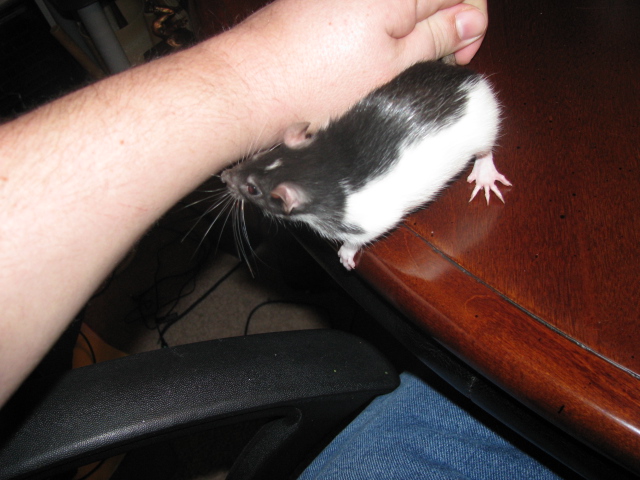
Anyway, Cupid was very special. She would let you pick her up and take her anywhere. She would let a hyper child with autism hold her. She would ride on our shoulders and nestle into anyone's long hair. She was cute and loveable. She could teach you to enjoy a rat's company. My son was very attached to her. I hated what I had to do. I hated to deliver the news as well. He fell into my lap when I told him she had to go last night. He cried for a good ten minutes as I discussed how I understood his feelings.
I offered to do a burial in the backyard and he accepted readily. Out in the back yard is the remains of an old stump someone tried to burn out. It's center was only dirt and ashes. Looking around the yard, I realized that there would likely be nothing under the stump. It should be safe to dig there. So I did and I managed to get the hole a good foot and half deep before digging into hard clay. We put poor Cupid to rest there and my son said a few words of goodbye. Then we filled it in and talked some more.
Loss is a hard change and change is already hard for autistics. All you can do, is be supportive and understanding. Offer to do things that help bring closure and remind of the good times. Don't go for instant replacement. Time is needed to get full closure or anything close to that. In getting a new pet, you shouldn't be getting a replacement. You should be getting a "new" pet, with an identity and history all it's own. That way, you don't find yourself constantly looking at this new animals as a replacement for Fido or who ever.

We still have a family of pets that need our love and support. We still have a big ol boy rat named Mocha Joe who needs attention. He's not the same, but we still have him and he is who he is. My son will be fine, but it's a tough loss for any child, conditions or not.
Tuesday, August 9, 2011
Everyone needs support in autism parenting

The last couple of days have been a rocky ride for me. My own medical conditions have been slapping me around and making it hard to get things done. Still, I have managed a few things and made a decent weekend for a family visit. In recent events, I have found a challenge. Well, it's been there all along, but you may be able to relate.
This challenge is in co-parenting an Asperger's child or any child with special needs. This challenge is support to the child and the other parent. Support has to go in all directions. While that sounds simple in words, the application is anything but.
The most obvious need of support is the child. His difficulties in dealing with the world around him demand it. He has a lot of development to catch up on and the world isn't likely to be forgiving. Half the time, it's definitely not forgiving. One of the lessons recently cited to my son is this: "Our condition is not an excuse to break rules". Discipline can be tricky however thanks to sensory issues. I can't spank him, it will cause a full blown meltdown for hours. Yes, a long long time ago, I was a parent who used spankings. I don't anymore.
Next there is the co-parent, and even more challenging, the step-parent. A step-parent is walking into a whole new world and it's quite an eye opener. For an accurate view on what this is like, please check out my fiance's blog:
http://aspergerblender.wordpress.com/2011/08/08/actions-and-re-actions/
It's more than a little frustrating for both parents in this situation and you have to support each other just as much as you work to support the child. You have to remind each other that it's going to be okay somehow and that each others feelings are valid. The second part of that is actually the most important. It's okay to feel frustrated, you have every right.
I can't tell you how many times I've sat down to explain consequences and behaviors to my son and got reactions that just didn't fit. Many reactions suggested that he never got the message I was trying to deliver. I would have to prod at that time and ask him if he was hearing me. I would have to remind him that I wasn't talking about the fantasy things and needed him to hear me. I often ask him what I'm talking about. Sometimes, for that, he shakes his head hard and get's angry, and says: "I just don't know!" He doesn't like to talk about his behavior.
On another note, he's actually angry with himself and we have to watch out for that one. He'll actually call himself "crazy" and "bad". That's not psychologically healthy either, so has to be intervened. I tell him he's not crazy or bad and that he has behaviors to learn like anyone else his age. I tell him we are just trying to help him learn them and he's not always going to like how that is done. No one does, and everyone has to learn. It's all that can be done at that point.
Yes, therapy is important and support in other places like school is too. But, one the spot, in the moment, this is what you are left with. There's the child's pain because he doesn't understand himself; your own pain and stress from worry; your parenting partner's pain and stress; and worry for each other. What else can you do? See it for what it is, call it like it is, listen to each other and support each other.
Wednesday, August 3, 2011
Sensory school supplies

Now that the school year is drawing in close, it's time to get school supplies for many of us. As we do this, I wonder how many of us are on the watch for things that are "sensory friendly"? I'm not necessarily talking about pens and pencils, but anything at all that you would need to get for your child. In the world of our senses, it's amazing what can trip us up when they are turned up too high.
In clothing, seams and scratchy material are the enemy to many an ASD child. It can cause high distraction and inability to sit still for very long. That's minding that our kids don't sit still long in the first place. Tags aren't ASD friendly either. Thankfully, there are tagless shirts out there. Some companies are printing their information right on the fabric. That has to be helpful right? If you inspect the clothing you buy (and I bet you do) you can see what kind of tags are easiest to cut out without damaging a shirt. You can also see what kind of seams are just too stiff to soften. Most T-shirt seams are pretty soft, but you know your child's sensitivities better than anyone. What about the designs printed on the shirts? Are they really stiff also? Don't forget socks either. Look for seamless designs in socks that fit to your child's size. You can order specialties online.

When dealing with clothing, a good practice is to always wash all new clothes with a good dose of fabric softener before wear. You'll wash out any "fillers" used by the companies to keep the clothes from wrinkling on the sales floor. Those are most commonly used in jeans, but I've heard of them in shirts too. This will still go a long way toward making clothing softer and more comfortable.
Now, what about pens and pencils? I've actually heard of children who don't like the pencils and pens with flattened sides on them. I think this is particularly rare, but maybe your child is one of them? I've come to wonder if this may get in the way of an ASD child's handwriting? If it's uncomfortable or distracting to use such an implement, wouldn't it make the task harder? Our kids can't necessarily tell us, so maybe a few experiments are in order.
Then there's markers. Unscented is the way to go, as well as washable. I don't know about all our kids, but marker scent gives me a headache. Scent is one of my downfalls with my own condition. It's that way for my son too. Then there are those who like the scent a little too much. Either way is a distraction in class.

Some of our kids are very sensitive to sound. I've seen that some schools have headphone ear protectors that make it easier for some kids. You can also order these from locations online. Now is the time to get prepared. Some of these items are not cheap, so the earlier you get them the better.
Best of luck and a great start to all our kids' new school year.
Thursday, July 28, 2011
Asperger's and Child frustration

I was going to make this blog about sensory issues and getting school supplies, but something happened. It's going to have to wait for next time.
My son is showing me that he can be sneaky, but that's not the issue either. It did lead to what happened.
Last night, my son told me he felt tired and wanted to go to bed early. That's not an unreasonable request. If he's not feeling well, he should get some rest. So I said "okay" and we did all the night time things you do before you go to bed. Then I tucked him in and that was that. Well, that's what I thought anyway.
An hour or so later, my son called frantically from his bedroom and I went to see what the issue was. As it turns out, he had slipped his Nintendo DS into bed with him and now it was broken. He gets limited time with video games to keep him from sinking into them and never coming out. This isn't the first time he's pulled the 'sneak it into bed' for extra play trick either. And who didn't sneak a comic book and flashlight into bed at some point in their childhood?
He broke the DS right at the hinge because he became angry with it. It ran out of power and turned off in the middle of his game. He got angry and in that moment of child frustration he must have wrenched it in his hands to break it.
The consequences for this are clear. He gets to tell his mother what he did (this was a Christmas gift from her) and he will have to use all his allowance to replace it. This will take a long time. The Ipod and DS were already banned from being in his bed from the last sneak episode. Now they are banned from his room altogether for supervision's sake.
Generally, the rule is this: if he breaks it in anger it doesn't get replaced. That's a fine rule for most toys. But now I find myself faced with the expensive ones that have a bit of investment. I also find myself worried for him. I worry about him learning to control the spontaneous rage that we can be afflicted with at a moment of frustration. I went through the same thing at his age. It has taken me into my adult life to learn how to control it. I don't want that for him.
This impulse behavior is not uncommon in our spectrum children. The only way to deal with it is with direct consequences and to point it out specifically to our kids. We have to teach them about that specific impulse and what it means. That is the only way, by making them specifically aware of it, that they may eventually learn to control or stop it.
Are you having a similar issue with your spectrum child? Feel free to post in comments. Your email is private and you will not be spammed.
Monday, July 18, 2011
Back to School for 2011

So far, I think I have been blessed in the schools that my son has attended. I have consistently found understanding faculty who are at least halfway knowledgeable on Asperger's and autism. I'm sure there will be points in getting to know my son, but we have always been able to deal with that.
This is an important time. For many of us, school starts sometime in the next month. It's time to be thinking about how to be active parents in our children's school lives. I have a few tips that you may find helpful.
1: Make sure IEP's are up to date and check with the school on it a new meeting is needed. Sometimes they don't need one or have a time scheduled based on the last time you had a meeting. Double check on it. Have information from the last IEP ready if you kept it from last year. If you didn't keep it, you should have. Make that a new habit. Keep a file folder for your child's education information.
2: Meet the new teacher and see the new classroom. Let the new teacher know that you are readily available for any questions or needs regarding your child. Exchange emails, most teachers have them now. If your child will be spending time with a special education teacher of any kind, meet him/her too.
3: Get needed school supplies. That's a no-brainer, but some of our students need special supplies. Those are better found sooner than later.
4: Being an active parent means that you are readily available for anything. It means that you are involved and open in communications with the school staff. It means you ask questions and want to know how you can help and where. You don't have to join the PTA or volunteer all over, just be involved where your child is concerned. Be ready to help with behavior issues or questions that help staff get to know your child.
5: Know how to communicate. Asking what you can do to help is way better than demands of the staff to "do their jobs". Demands have their place and are best used when all other approach has been exhausted. Don't start out the school year with demands or veiled legal threats. Be pleasant and polite instead. It will get you much further faster.
Things that staff need to know:
1: Triggers: What affects your child and how it affects them. Will a fire alarm incite hysterics? If so, they need to know this ahead of time. Do they have a problem with being touched? Let the faculty know. Let them know the risks involved too. If your child is high risk for self injury, for example, schools need to know. They especially need to know what causes those reactions. They can't cover everything, but knowledge is power.
2: Medications: They especially need to know if there has been a change to meds and what to watch out for. If there are any concerns with a new medication that could have any affect on the classroom, make sure you communicate it.
3: Quirks and stims: These can be some of the most eyebrow lifting moments in a classroom. What the heck is Joe doing and why? Quirks and stims are nearly limitless in what they can involve. They can be surprising and sometimes disturbing. Understanding them is a great step toward helping a child in a classroom environment. Also, forewarned is truly forearmed.
Remember, you don't want them to re-create the education system. You just want to help them work with your child. You just want to be a part of his or her educational team.
If you are at a school that won't do this, that is a different story.
Monday, July 11, 2011
How to get your important message across, or not

In autism, just like with many things, there are differing sides, issues and beliefs. For each of these there are people who feel very strongly. This is understandable, however, some feel so strong about their thoughts that they fall into a state of fanaticism.
Fanatics are hard to deal with, especially if they don't quite have their facts straight. I'm not aiming at any particular group here, (that would be particularly dangerous) but I do want to point out a few ways you won't get your point across.
Extreme measures have their place. Take a peaceful protest march of thousands to the White House or a State Capitol somewhere. That's extreme, but it has worked to make political and human rights points in history. The key to an extreme measure working is choice. People choose to get involved and the do so because they believe in what the protest stands for.
Now I'm going to say something harsh but it's also very important if you want to get your point across: Misuse of an extreme measure will only make you look like a lunatic. To avoid that, you have to use your media with care and present your message in a politically correct fashion. I know, I'm not always that politically correct, but bear with me. The most of what I miss is usually he/she reference. I stick with just one and it's meant to be in respect that there are two or what not. I have been attacked for that before.
So, here are some important points to consider about delivering your message:
1) FACTS: Have you researched your information and are you using verifiable facts? For example, if you go around calling people with Asperger's liars for saying they have autism, you would be hurting your case. Asperger's is recognized by every medical board in the world as an "Autism Spectrum Disorder". Recently, they have considered making its diagnosis separate for identification issues and there is an ongoing argument, still: that doesn't change what it's been accepted as for years, a form of autism. Conspiracy theories of many kinds are famous for getting blown out of proportion to a point of inciting panic. This doesn't help the point that needs to be made, or the message. So, make sure you have your facts straight before you go on the warpath.
2) DELIVERY: How are you getting your message out? Do you write blog articles like me? Do you have a website? These can be very good ways to deliver your message. You will have to write for a while to start getting attention, but keep going and time will bring readers to you. But what if you want to skip that time needed? Maybe you decide to gather friends on Facebook and then launch emails at hundreds of them at a time with your message? Watch out. That could get you in trouble for spamming. You may have an important point, but if try to flood people with it too much, too fast, you will only annoy and turn them off to your message. And you can't please everyone, no matter what you do. I've been called a ranter plenty of times. You can't reach everyone either. Some people are dead set in what they believe, right or wrong. You have to let them go and get on with what's important, those who are listening and your message.
3) IS IT FRIENDLY? A true mark of a bad fanatic is someone who insults everyone that has a different point of view. I'm talking about someone who calls people racial slurs, drops obscene language makes horrible references against opposing opinions, just because their opposing opinions. This person will ignore all facts presented and not take any time to look at perspectives or respect others. If you don't believe they way they do, you're scum. Don't be one of these. You will have a select and small group of listeners, sure but your message won't get far. You will turn off people left and right. Even people who are famous for such attitudes are limited in number. Even they don't get away with calling people much more than "stupid". As soon as I get slighted like that for my opinion, that person loses all credibility with me. I've had some strong opinions of people too in my day. Thankfully, they've either been a learning experience and never been obscene with a torrent of swearing and worse.
Honestly, if you can steer around those three obstacles, you can gather quite a following to your points and probably even get something serious accomplished. The internet can be an awesome tool for this, or it can lead to your destruction.
Subscribe to:
Posts (Atom)