Across the nation we are officially back to school. Maybe a few aren't, but most are. Going back to school means change in schedule and likely a few meltdowns and tantrums. I'm writing this today to touch base on a few reminders that may help you through the transition.
Remember what you learned last year and the year before that. If you've done this more than 3 or 4 times, you should be prepared for resistance. That won't make it any more fun to deal with, but better prepared thinking than not. Consider techniques you used last year and use them again this year.
Don't engage the tantrum: This is especially true with autistics. We can be a very argumentative bunch. Kids already have this angry debating skill. Do your best to stay cool and not react to the tantrum. State your expectations and then drop it. Apply consequences after you get what you want out of the situation and when everyone has calmed down.
Don't apply consequences before going to school if it only further triggers your child into a fit. I have direct experience with this. The idea is getting your child to school, hopefully in a mood that won't destroy their school day. Leave discussing their behavior and any consequences for when they get home. "Remember how you used all those swear words this morning? No video games tonight." This way, you got them to school and gave consequences at a time where you have more time and control.
Remember to reward the behaviors you want. If your kid is handling transition better than last year, tell him! Be happy with what he does right and praise it. Give rewards. A good reward system is always important, even if it isn't worth a hundred bucks. You don't have to spend lavish funds to give rewards. The simple things can be very effective.
Give down time after school. Don't expect your child to go straight to homework the second they walk through the door. He or she has spent the last 8 hours struggling to behave and jump through school hoops. A break after school is welcome and kind. Set up a routine. Offer half an hour of break time to do what ever they want (save anything they can't do because of behavior) with the knowledge that it's homework time after that. My son actually prefers to get right to it, but he always has the option of that after school break.
Hopefully, these tips help you handle the new transition that we all have to wade through. Age doesn't seem to help, so we must be vigilant parents. Have tips you'd like to share? Post them in comments!
Do you or your kids love heroes? Add the Galaxy Zento page! Books and games for ages 8 and up are available. The work of GZ is dedicated to showing our autistic youth that you CAN DO even with a few struggles. Life get's better so never give up. The GZ page is loaded with cool artwork and updates!
Showing posts with label back to school. Show all posts
Showing posts with label back to school. Show all posts
Wednesday, August 19, 2015


Wednesday, August 31, 2011
Autistic student: Reeling them in for homework

Staying on task is hard for many of our spectrum students. It's even harder when the topic at hand isn't their main interest or an interest at all. There's a lot of redirection involved, especially at first and early in the year. It's frustrating, mentally taxing and can leave you drained. It can still pay off, though, so it's important to never give up.
The first problem we face is the time of year. It's only the beginning of the school year so this is a change in routine. It's not a small change either. There are many expectations that just weren't there for the summer. Try as you might, even with some extra activities and camp, you just can't recreate those expectations (on your own anyway) during off-school months. So this will be a period of adjustment with new routines. Thankfully, we have been blessed this year with good mornings in the way of getting up and getting dressed without fits. And now he's learning to make his own breakfast (cheers!). So, as years go by, improvements are quite possible.

The second is making the switching of tasks through the day part of his routine. It's all routines inside of each other and he balks at them. My son has had difficulty calming down for class in the mornings, (no doubt because of all the sensory input from excitement and hustle bustle) and has had to leave class a few times to recalibrate. I will say his teachers are on the ball with him. We are blessed to have such proactive teachers this year. But for all of our kids, we have to remember this goes hand in hand with number three.
The third is major sensory input. Crowds of children are loud and noisy. Hallways echo, and there's constantly someone bumping into you. At some ages, our kids are starting to put on deodorants and colognes and our sensitive kids will smell this at a distance. Kids with hygiene problems will be there as well and add to the mix with smells of their own. Not all of them will be triggers, but some will be and likely have been for some time. And let's not forget temperatures, those can have drastic effect too. Especially heat as it increases irritability.

Now I get to homework. It's another area of routine that we know our kids hate. It's more school after the school day has let out. What kids wants that? Well, it's a fact of life and they have to do it. For us, toward the end of the day, my son is more embroiled in fantasy from holding back all day (or being steered back to reality all day) and he just wants to play. Bringing him in from fantasy to get started on that homework is kind of like reeling in a really big fish. It's a fight for a bit, but once he's in the boat it gets easier.
The next issue in homework is getting overwhelmed and giving up repeatedly. He still has to learn to slow down and take his homework or any problem a bit at a time. He wants to rush, skip steps and be done. This is pretty common of our spectrum kids. It's especially common with Asperger's or ADHD kids. You get the idea. Ours may throw a fit and close down. We give him a break, but he can't go back to play or have privileges until he does that homework. So, piece by piece it gets done. It can be tedious and tiring for everyone involved too.
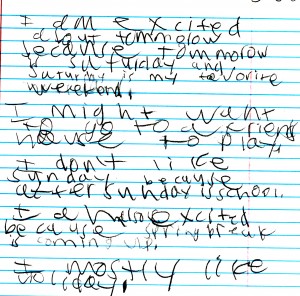
Handwriting is still a vexing issue too. It's like having something to concentrate on inside of everything else. My son is working on it, but it takes as much redirection and do-overs as anything else. Sometimes, by the time he has to rewrite something, he's forgotten the what the problem was and has to rethink it too. That's frustrating for him. I'm sure it's the same for many of our kids. Think about it, how much can your brain juggle?
It's easy to feel like this will never improve, but the truth is, that it can. If he's able to keep trying over and over again, then he may and likely will improve. That's not a guarantee of course. But, look back over your child's school history and make it appoint to notice the improvements. Has your child improved while moving up in grades? Then there's distinct hope. Has he improved despite lack of support or in the face of other difficulties? Then there's major hope.
So here's to moving on in a new school year (or getting started for many of you). Keep your chin up and never give up.
Wednesday, August 3, 2011
Sensory school supplies

Now that the school year is drawing in close, it's time to get school supplies for many of us. As we do this, I wonder how many of us are on the watch for things that are "sensory friendly"? I'm not necessarily talking about pens and pencils, but anything at all that you would need to get for your child. In the world of our senses, it's amazing what can trip us up when they are turned up too high.
In clothing, seams and scratchy material are the enemy to many an ASD child. It can cause high distraction and inability to sit still for very long. That's minding that our kids don't sit still long in the first place. Tags aren't ASD friendly either. Thankfully, there are tagless shirts out there. Some companies are printing their information right on the fabric. That has to be helpful right? If you inspect the clothing you buy (and I bet you do) you can see what kind of tags are easiest to cut out without damaging a shirt. You can also see what kind of seams are just too stiff to soften. Most T-shirt seams are pretty soft, but you know your child's sensitivities better than anyone. What about the designs printed on the shirts? Are they really stiff also? Don't forget socks either. Look for seamless designs in socks that fit to your child's size. You can order specialties online.

When dealing with clothing, a good practice is to always wash all new clothes with a good dose of fabric softener before wear. You'll wash out any "fillers" used by the companies to keep the clothes from wrinkling on the sales floor. Those are most commonly used in jeans, but I've heard of them in shirts too. This will still go a long way toward making clothing softer and more comfortable.
Now, what about pens and pencils? I've actually heard of children who don't like the pencils and pens with flattened sides on them. I think this is particularly rare, but maybe your child is one of them? I've come to wonder if this may get in the way of an ASD child's handwriting? If it's uncomfortable or distracting to use such an implement, wouldn't it make the task harder? Our kids can't necessarily tell us, so maybe a few experiments are in order.
Then there's markers. Unscented is the way to go, as well as washable. I don't know about all our kids, but marker scent gives me a headache. Scent is one of my downfalls with my own condition. It's that way for my son too. Then there are those who like the scent a little too much. Either way is a distraction in class.

Some of our kids are very sensitive to sound. I've seen that some schools have headphone ear protectors that make it easier for some kids. You can also order these from locations online. Now is the time to get prepared. Some of these items are not cheap, so the earlier you get them the better.
Best of luck and a great start to all our kids' new school year.
Monday, July 18, 2011
Back to School for 2011

So far, I think I have been blessed in the schools that my son has attended. I have consistently found understanding faculty who are at least halfway knowledgeable on Asperger's and autism. I'm sure there will be points in getting to know my son, but we have always been able to deal with that.
This is an important time. For many of us, school starts sometime in the next month. It's time to be thinking about how to be active parents in our children's school lives. I have a few tips that you may find helpful.
1: Make sure IEP's are up to date and check with the school on it a new meeting is needed. Sometimes they don't need one or have a time scheduled based on the last time you had a meeting. Double check on it. Have information from the last IEP ready if you kept it from last year. If you didn't keep it, you should have. Make that a new habit. Keep a file folder for your child's education information.
2: Meet the new teacher and see the new classroom. Let the new teacher know that you are readily available for any questions or needs regarding your child. Exchange emails, most teachers have them now. If your child will be spending time with a special education teacher of any kind, meet him/her too.
3: Get needed school supplies. That's a no-brainer, but some of our students need special supplies. Those are better found sooner than later.
4: Being an active parent means that you are readily available for anything. It means that you are involved and open in communications with the school staff. It means you ask questions and want to know how you can help and where. You don't have to join the PTA or volunteer all over, just be involved where your child is concerned. Be ready to help with behavior issues or questions that help staff get to know your child.
5: Know how to communicate. Asking what you can do to help is way better than demands of the staff to "do their jobs". Demands have their place and are best used when all other approach has been exhausted. Don't start out the school year with demands or veiled legal threats. Be pleasant and polite instead. It will get you much further faster.
Things that staff need to know:
1: Triggers: What affects your child and how it affects them. Will a fire alarm incite hysterics? If so, they need to know this ahead of time. Do they have a problem with being touched? Let the faculty know. Let them know the risks involved too. If your child is high risk for self injury, for example, schools need to know. They especially need to know what causes those reactions. They can't cover everything, but knowledge is power.
2: Medications: They especially need to know if there has been a change to meds and what to watch out for. If there are any concerns with a new medication that could have any affect on the classroom, make sure you communicate it.
3: Quirks and stims: These can be some of the most eyebrow lifting moments in a classroom. What the heck is Joe doing and why? Quirks and stims are nearly limitless in what they can involve. They can be surprising and sometimes disturbing. Understanding them is a great step toward helping a child in a classroom environment. Also, forewarned is truly forearmed.
Remember, you don't want them to re-create the education system. You just want to help them work with your child. You just want to be a part of his or her educational team.
If you are at a school that won't do this, that is a different story.
Subscribe to:
Posts (Atom)